The challenge
Operational knowledge and expertise often become tied to the operator, limiting the owner's visibility and making it difficult to prevent problems before they occur.
Event Owners
Daily venue operations generate valuable knowledge, experience and operational know-how. With Sapluna, this knowledge remains with the venue owner even when day-to-day operations are outsourced to an external operator. At the same time, the owner gains continuous visibility into operations and can manage the venue proactively rather than simply reacting to problems after they occur.
Event Owners
Event owners · own the operating model
Result
The venue owner retains ownership of critical operational knowledge while operators focus on delivering and improving services. Operations become more predictable, less dependent on individual organizations and easier to develop over the long term.
The Challenge
Many venues operate with separate ownership and operational responsibilities.
For example, a municipality may own a public square, sports arena, cultural center or event venue while outsourcing daily operations to an operator. The operator handles bookings, customer service, sales and marketing, service development and daily operational management.
Over time, operators accumulate significant operational knowledge, including:
The challenge arises when the operator changes.
Customer information, operating practices, project history and accumulated know-how often become closely tied to the operator. As a result, the venue owner may find itself starting from scratch even though the venue, brand and services remain unchanged.
In traditional operating models, the owner's role is often reactive. When the operator develops and manages its own processes and systems, visibility into daily operations becomes limited. The owner typically becomes aware of problems only after they have already impacted service quality, customer satisfaction or business performance.
The real challenge is not only ownership of information but also the ability to identify trends and risks before they become operational problems.
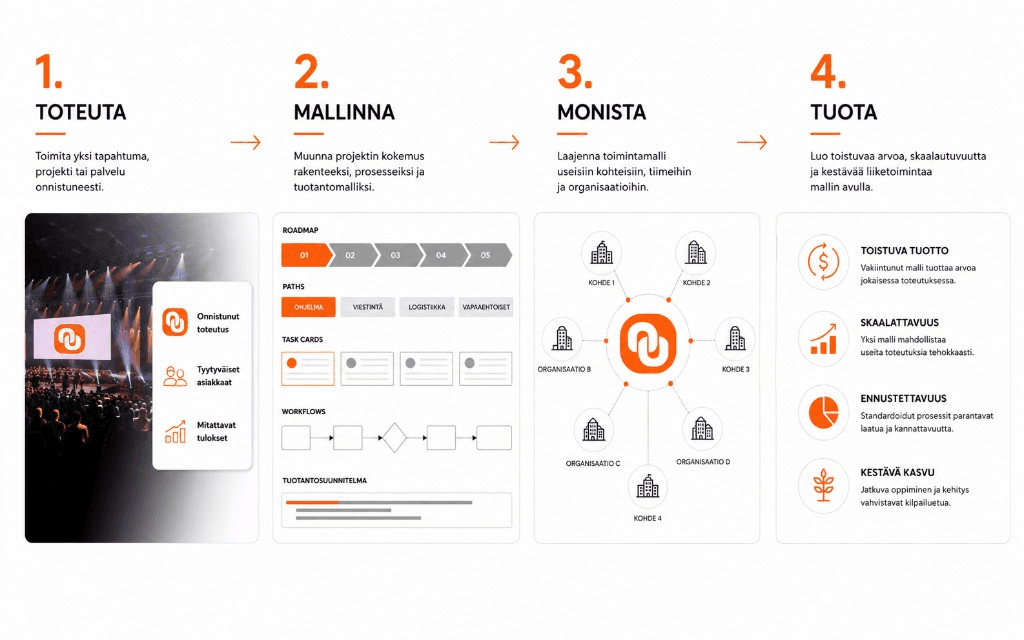
The Sapluna Path Model
Venue Operations Path
01 Model Definition → 02 Operational Improvement → 03 Operational Use
With Sapluna, the owner manages operations through a shared operating model and gains continuous situational awareness.
Tasks, processes, documents, feedback, improvement initiatives, reporting and decisions are managed in one place. This creates visibility and analytics that help identify trends, risks and operational challenges before they escalate.
Model Definition
The venue owner creates a shared operating model that defines:
The model can be created before an operator is selected. The owner gathers perspectives from multiple stakeholders, including current and former operators, staff members, partners, customers and industry experts. As a result, the model reflects collective experience and best practices rather than the viewpoint of a single organization.
Operational Improvement
The operator follows the model in daily operations while contributing practical expertise. Within Sapluna, users can:
Knowledge is transformed from individual expertise into a shared operational asset.
Operational Use
The operating model supports:
The owner retains ownership of the operating model regardless of who is responsible for day-to-day operations.
Example Workflow
The venue owner defines common principles, responsibilities, objectives and operating practices in Sapluna. The model is developed by gathering input from current and former operators, staff, partners, customers and industry experts. This creates a shared understanding based on collective experience rather than the perspective of a single operator.
The selected operator adopts the operating model and manages daily activities according to the agreed framework.
Customer feedback, observations, development ideas and operational experiences are documented within Sapluna.
The owner and operator review operational results, observations and performance indicators together and decide on necessary improvements.
Successful practices are incorporated into the shared model, enabling continuous improvement.
The owner maintains continuous visibility into operations. Risks, quality issues and operational challenges can be identified before they affect customers.
If the operator changes, a new operator can continue using the existing model without losing valuable operational knowledge.
Results
The challenge
Operational knowledge and expertise often become tied to the operator, limiting the owner's visibility and making it difficult to prevent problems before they occur.
How Sapluna helped
Sapluna creates a shared Venue Operations Path where processes, responsibilities, reporting and continuous improvement are managed through a single operating model.
The outcome
The venue owner retains ownership of critical operational knowledge while operators focus on delivering and improving services. Operations become more predictable, less dependent on individual organizations and easier to develop over the long term.
More in this category